Essay AI Video for Advertising
AI Video Creative Testing Frameworks for Paid Social
Closed-loop testing turns AI speed and human judgment into competitive advantage.
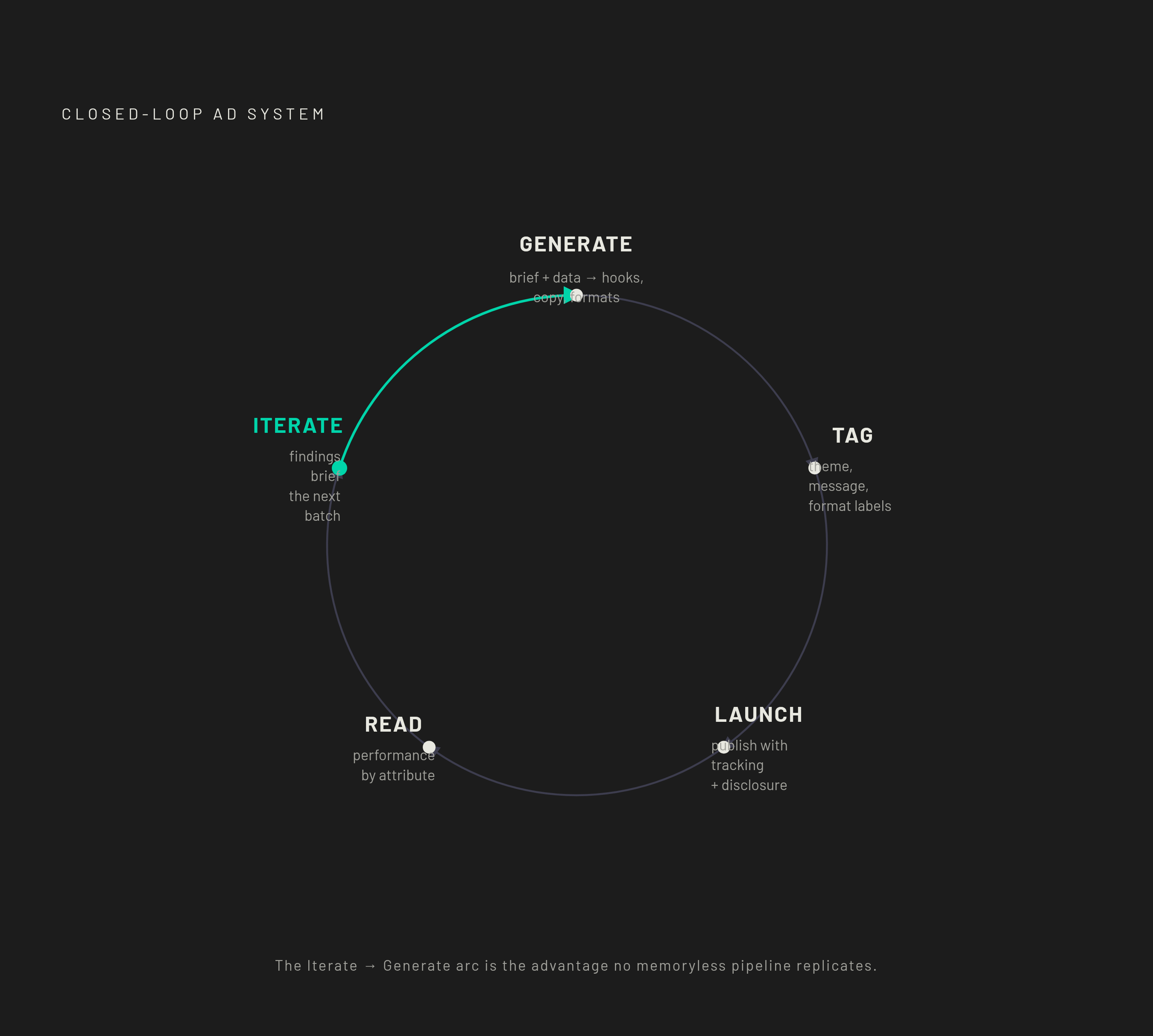
AI video creative testing for paid social is now a closed loop. The framework connects generation, tagging, launch, performance reading, and iteration. Its strength comes from human checkpoints that help the team learn from each round, while automation lets it produce and spend faster.
Why creative testing has become the primary operational discipline in paid social
Creative diversity now helps determine which ads get delivered. Meta’s Andromeda update elevated it as a factor in delivery decisions, increasing pressure on advertisers that rely on a single creative set across broad audiences. Multiple concepts give delivery systems more options than small changes to the same idea. Creative quality is therefore an operational concern.
Fatigue adds another constraint to that pressure. On Meta and TikTok, relying on two or three video ads a month is no longer sufficient to maintain stable acquisition costs. Underperforming combinations can be deprioritized within days to weeks, while shorter creative lifespans narrow the time available to learn. The work has become a daily discipline.
Together, creative-diversity weighting, tighter financial margins, and fatigue change what a paid social team needs to do well. Producing an asset is only part of the job. The team also needs to discover why it worked and turn that finding into the next useful test. In 2026, the competitive moat is the loop.
What a closed testing loop actually means — five stages that have collapsed into one
Generate turns a brief, brand kit, and prior performance data into batches of hooks, copy angles, and formats. Tag gives each published ad structured labels for its theme, message, format, and creative elements. Those labels make comparison possible across different assets. Without them, the next stages can identify a winning ad but struggle to explain the win.
Launch publishes the tagged variants with tracking and disclosure metadata attached. Read looks at how ads perform by attribute to find themes, hooks, and formats that earn engagement across ads. Iterate uses what the team learned to brief the next batch. The output becomes an input to the next round.
Canva Grow 2.0 illustrates this connected shape through ad creation, AI Ad Tagging, Bulk Publish, performance insights, and Automatic Refresh Generation. It is one possible route. The framework’s five stages name the jobs to be done without requiring a product to have five features. As more of the sequence runs automatically, teams must protect the quality of human decisions at its gates.
Hypothesis-first testing logic — why concept testing must precede variation testing
The generate stage needs a question before it needs assets. A useful framework starts with a hypothesis about performance, tests it under controlled conditions, and feeds the result into production. Without that direction, an extensive batch can still leave the team unsure what it learned.
Concept testing asks whether one message resonates more than another. For example, a team could test “price savings” against “time savings” with static images or text overlays before committing to video production. If time savings earns a useful signal, variation testing can then compare three hook executions of that angle. The first test chooses the message. The second refines how that message is delivered.
That sequence protects the production budget from an avoidable mistake. Different presenters, visuals, and calls to action can polish an idea without showing whether it works well enough to spend money on. The angle needs to be validated cheaply before its execution expands. Otherwise, variation testing compares versions of an idea that may be wrong.
Modular creative architecture — how breaking a video into testable units multiplies learning without multiplying cost
Instead of treating every video as an indivisible asset, the team separates the hook, visuals, script, presenter, and call to action into testable units. Hooks come first for a simple reason. Nobody watches the body of an ad that fails to stop the scroll.
One hook can run with product closeups, lifestyle visuals, before-and-after treatments, or unboxing footage to compare visual response. One script can use different avatars or voices while keeping the same words and pacing to test which tone or presenter people respond to. A shared message and CTA can also run across formats and aspect ratios to test placement fit.
Some generators work well for environmental and physics-heavy shots, while others are better at realistic facial micro-expressions. Voyager brings Claude, ChatGPT, Kling, DeepSeek, and other frontier systems into a single dashboard, supporting a model-per-shot approach without separate interfaces. The structural benefit is coordination.
Tagging discipline — why structured attribution is the mechanism that turns volume into learning
Tags are what make a large creative batch learnable. An ad ID tells the team which asset performed well, but structured attributes let it compare hook types, visual formats, and message angles across the account. That changes the unit of analysis. The team now identifies which element earns engagement repeatedly.
Segwise.ai illustrates this approach by using multimodal AI to tag hooks, CTAs, characters, visual styles, and audio, then connecting those elements to performance metrics. Its generative loop can use winning patterns to inform new creatives. The important connection runs from element to result. A label has little value if it cannot help shape the next brief.
Metrics then give those comparisons a purpose. Outbound CTR serves as an intent signal, while ROAS and CPI connect creative attributes to other performance outcomes. These measures do not mean the same thing. The framework calls for tagging to happen automatically at publish, with people periodically auditing the taxonomy so that labels remain consistent. Without those checks, changes in the names may create apparent patterns in audience response.
On Meta and TikTok, relying on two or three video ads a month is no longer sufficient to maintain stable acquisition costs.
The three human gates that must survive the automation
Automation needs authority limits. The first gate is creative concept approval before anything enters the ad account. A predictive score may help sort candidates, but it cannot settle whether an idea fits the current category. An ad can score well against training data and fail because the market has moved toward a format that data does not represent.
The second gate is brand safety and AI-disclosure compliance before spend begins. The team is still responsible under the law for offer claims, pricing accuracy, and labeling requirements, and its reputation is at stake. A fast launch is useful only after the creative has cleared those checks.
The third gate is budget authority before scaling an early winner. Platform optimizers favor early engagement, but a person must decide whether the signal is statistically meaningful or an artifact of delivery bias. That decision includes protecting the read window. Ending a test early can leave the team with money spent and too little evidence to draw a conclusion, even when platform rankings push it to act.
Conversion data alone cannot explain which part of an ad failed, so people still need to interpret the tagged results before approving the next direction. With repeated cycles, experienced creative judgment can become sharper at each gate because the team has a richer record of ideas, outcomes, and mistaken assumptions.
Adaptive memory as a compounding creative brief — how the loop gets smarter over time
A system that remembers fatigued hooks, converting angles, and formats that underperformed by audience segment starts from a different place than a generic prompt. It has a performance history to work from.
Persistent-context AI is one way to carry that history forward. In autonomous agent workflows, infrastructure-level memory can include core, recall, and archival tiers, allowing agents to save, edit, or forget project information over time. Applied to paid social, the principle is straightforward. The brief draws on the account’s performance archive as well as its brand guidelines.
That memory still depends on the preceding human decisions. A premature winner or an unreliable tag is a poor foundation for the next batch, however efficiently the system recalls it. The organizational move is therefore toward a creative data culture that connects briefing to live performance. Teams that build useful memory into the loop accumulate an advantage that memoryless pipelines cannot close through volume alone.
Testing infrastructure — matching the platform to the team’s scale and testing ambition
Tool selection follows from the testing structure. A team that makes modular videos needs a different production setup from one that first needs to fix inconsistent tagging. As the work grows, so does the effort it takes to move assets between generation, publishing, and reporting. The team needs to identify which connection to strengthen.
Canva illustrates a connected creation-to-refresh workflow, while Voyager supports multi-model production within a shared interface. Segwise illustrates attribute tagging linked to performance and subsequent generation. These are distinct roles within the same framework. Their usefulness depends on whether that role addresses the team’s actual testing bottleneck.
AdCreative.ai has predictive performance scoring that teams can use before launch and connects with Meta, Google, and LinkedIn. It ranks generated creatives by predicted conversion performance before budget is committed. That makes scoring useful for triage.
The best fit also leaves the framework’s decisions visible. Concept approval, disclosure checks, taxonomy audits, and budget authority do not disappear because several stages share an interface. A more connected platform can reduce handoffs. It cannot decide what the team is trying to learn or how much evidence will justify the next investment.
Where the loop breaks and how to recognize it before budget is wasted
If every batch contains new hooks and presenters but no validated message, the team is refining execution before resolving the concept. More output then accelerates spending on an untested premise. The warning is not weak production quality but the absence of a clear question behind it.
Tagging drift produces a different symptom. Reports name winning ad IDs, yet nobody can turn the result into a specific instruction about hooks, visuals, or messages. The labels no longer support a trustworthy comparison. When that happens, the read stage may still produce numbers, but the iterate stage has little usable evidence.
Premature scaling is another break in the chain. Early engagement can reflect delivery bias rather than repeatable creative performance, and platform spend efficiency is not the same goal as identifying a durable signal. Human budget authority keeps that distinction explicit. Similarly, rising acquisition costs despite greater output can signal an iterate stage that keeps revisiting fatigued ideas because it lacks memory.
A working loop produces a brief with a testable next move. Instead of “make more like this ad,” it can specify that the Skepticism hook outperformed Curiosity by a meaningful margin within an audience segment, then propose three Skepticism executions with two new visual treatments. The learning has become concrete enough to use. In that system, people deliberately set the brief, test design, read window, and iteration logic, while AI handles the volume needed to run the experiment.